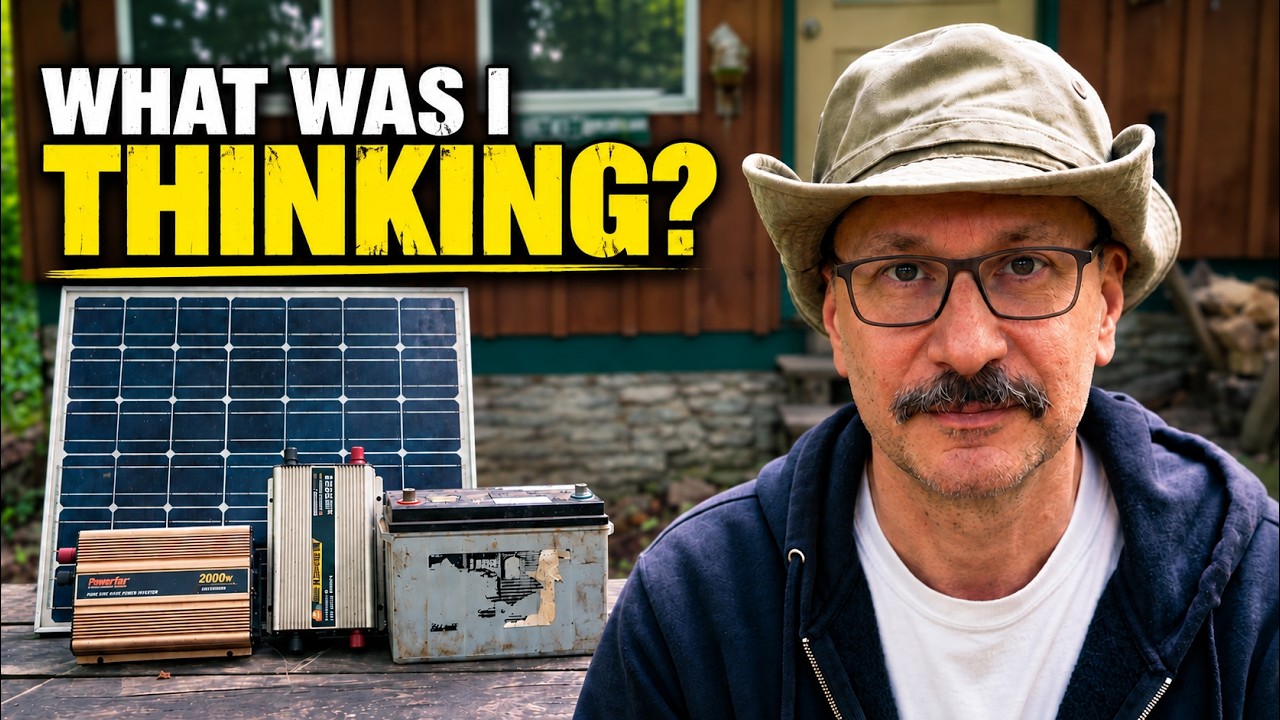
Two decades of off-grid living leaves behind a graveyard of expensive mistakes — gear that sounded essential, tools that couldn’t keep up, and equipment that died at the worst possible moment. In this hard-hitting video from CleverJoe Off Grid, the first lesson is brutally clear: off-grid self-reliance isn’t about buying the biggest or cheapest equipment — it’s about buying the right infrastructure the first time.
From flooded lead acid battery banks that rusted out in record time to an oversized generator that guzzled fuel without delivering value, every mistake in this list carries a real price tag. Whether you’re planning your first small solar setup for a rural retreat or refining a full-time homestead system that’s been running imperfectly for years, these lessons translate directly into money saved and downtime avoided.
What sets these two decades apart is the breadth of the errors — across power storage, generation, solar harvesting, cutting tools, inversion, and even vehicles. Each mistake carries a clear takeaway: what went wrong, why it failed, and exactly what to buy instead to ensure that your off-grid infrastructure doesn’t abandon you in the dead of winter.
Key Survival Takeaways
- Lead acid batteries are a false economy. They cost significantly less upfront but die quickly under the deep cycling that off-grid living demands. Most flooded lead acid banks need replacement every 3 to 5 years, while lithium iron phosphate (LiFePO4) batteries deliver thousands of cycles and can last a decade or more. Over 20 years, you’ll buy lead acid three or four times. Buy lithium once.
- Don’t oversize your generator. A massive generator sounds reassuring, but it burns fuel inefficiently at low loads and costs more to run, maintain, and fuel. The smarter approach is to match your generator to your actual continuous and surge loads, not your imagined worst-case scenario. A right-sized inverter generator running efficiently will outlast and outperform an oversized unit every time.
- Solar panel quality matters more than wattage. Cheap panels degrade fast, underperform in low-light conditions, and often have poor temperature coefficients that slash output when panels heat up. Investing in reputable monocrystalline panels from established brands means more consistent energy harvest year after year, even on overcast days.
- Chainsaws: gas isn’t always better. Battery-powered chainsaws have improved dramatically in recent years. For most off-grid firewood needs, a modern 40V or 80V battery chainsaw is quieter, lighter, requires almost no maintenance, and eliminates the fuel storage and carburetor headaches of gas models.
- Inverters must be sized correctly. An oversized inverter wastes power on idle consumption around the clock, draining your battery bank even when nothing is running. Calculate your continuous and surge loads precisely before buying, and choose a pure sine wave inverter that fits your actual usage pattern.
- Pickup trucks aren’t always the right off-grid vehicle. Fuel costs, maintenance complexity, and everyday practicality matter more than payload bragging rights. Sometimes a smaller, more fuel-efficient vehicle with a trailer is the smarter long-term choice for homestead life.
- The bonus mistake: underpowered equipment. Buying tools that are too small for your real workload wastes time and energy. Whether it’s a wood splitter, a water pump, or a charger, always size your equipment for your actual demands, not your minimum ones.
What to Buy Instead: A Quick Reference Guide
- Battery bank: Skip flooded lead acid. Go straight to LiFePO4 (lithium iron phosphate) — specifically 12V or 48V systems sized to your daily watt-hour consumption. A 100Ah LiFePO4 battery at 12V gives you ~1,280 usable watt-hours and will outlast 3–4 lead acid replacements.
- Generator: Choose a 2,000–3,000W inverter generator that matches your surge loads. Run it only to top off batteries during cloudy stretches, not as a primary power source. Fuel consumption drops dramatically when the generator is properly sized.
- Solar panels: Buy tier-1 monocrystalline panels from brands like REC, LG, or Canadian Solar. A 450W panel from a reputable manufacturer will still be producing 80%+ of rated output in year 25. Cheap no-name panels often lose 20% output within the first few years.
- Chainsaw: A 40V or 80V battery chainsaw from Greenworks, EGO, or DeWalt handles 90% of homesteading firewood tasks. Keep a small gas saw as backup for felling large trees, but make the battery saw your daily driver.
- Inverter: Size to your largest continuous load plus 25% headroom. A 3,000W pure sine wave inverter covers most homestead needs without excessive idle draw. Look for low no-load current specs (under 1A).
Gear and Equipment
Building a reliable off-grid power system starts with choosing the right components and avoiding the mistakes outlined above. For energy storage, LiFePO4 lithium batteries are the gold standard, offering thousands of deep discharge cycles with minimal degradation compared to lead acid alternatives. Pair them with a quality 450W monocrystalline solar panel for efficient year-round charging even in less-than-ideal conditions.
A properly sized pure sine wave inverter ensures your electronics and appliances run cleanly without risk of damage from dirty power. For firewood processing, a battery-powered chainsaw offers quiet, low-maintenance cutting that’s perfect for off-grid homesteads where noise and fuel storage are concerns. And for backup power on cloudy stretches, a right-sized portable inverter generator fills the gaps efficiently without guzzling fuel.
As an Amazon Associate, we earn from qualifying purchases.
Frequently Asked Questions
Are LiFePO4 batteries worth the higher upfront cost for off-grid use?
Yes, absolutely. While a LiFePO4 battery costs 2–3x more upfront than a comparable lead acid bank, it lasts 3–4x longer, charges faster, accepts deeper discharges without damage, and requires zero maintenance. Over a 10-year period, lithium is significantly cheaper per usable kilowatt-hour than lead acid, and you avoid the hassle of replacing your battery bank every few years.
What size generator do I need for an off-grid cabin?
For most off-grid cabins, a 2,000–3,000W inverter generator is sufficient. Calculate your continuous loads (lights, fridge, well pump) and add the largest surge load (typically a well pump starting or a microwave). Choose a generator that handles your surge load plus 20% headroom. Avoid the temptation to buy a 7,000W+ generator — it will burn more fuel at idle and cost more to maintain.
Can a battery-powered chainsaw really replace a gas saw on a homestead?
For most firewood processing and limbing tasks, yes. Modern 40V and 80V battery chainsaws can cut through 12-inch hardwood logs with ease and run for 30–45 minutes per charge. Keep a gas saw for felling large trees or all-day cutting sessions, but for daily homestead use, a battery saw is quieter, cleaner, and far less maintenance.
How many solar panels do I need for off-grid living?
Start by calculating your daily watt-hour consumption. A typical off-grid cabin uses 3,000–5,000Wh per day. Divide by your average peak sun hours (typically 4–5 in most US locations) to get the minimum array size. Add 25–30% for cloudy days and system losses. For most homesteads, a 3–6kW solar array (7–14 panels at 450W each) provides reliable year-round power when paired with adequate battery storage.
Conclusion
Twenty years of off-grid living teaches you that every dollar spent on the wrong gear is a dollar you can’t spend on the right gear. The lesson is clear: do your research, buy quality once, and never assume that bigger or cheaper is automatically better. Learn from these mistakes before you make them yourself, and your off-grid journey will be smoother, less expensive, and far more sustainable in the long run.
The most expensive gear is the gear you buy twice. Take the time to understand your actual power needs, tool workload, and vehicle requirements before opening your wallet — your future self will thank you when the system runs flawlessly through its tenth winter.