



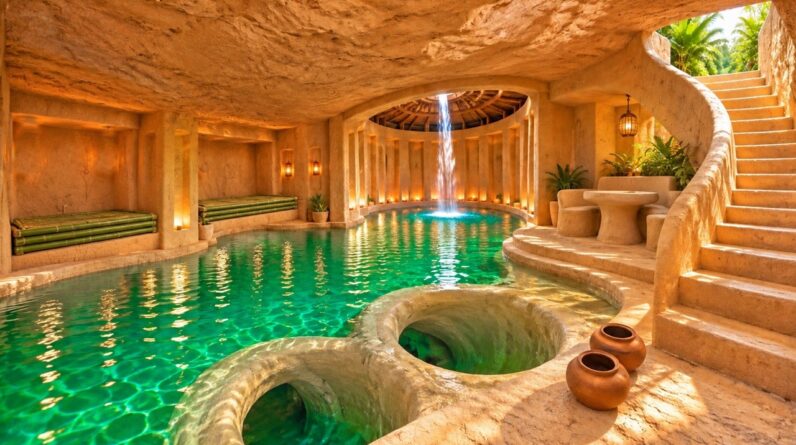
Long-term wilderness living and primitive architecture showcase how human ingenuity and earthworking techniques can transform raw earth into functional, sustainable subterranean shelters. In this ambitious project, primitive builders embark on a 100-day journey to design and construct an underground subterranean living structure equipped with integrated water features and earthwork amenities.
Utilizing basic hand tools, natural soil clay, and timber harvested from the surrounding forest, this build demonstrates impressive structural excavation, moisture management, and soil stabilization principles. Understanding the mechanics behind subterranean excavation and water retention provides valuable insights into primitive engineering and off-grid homesteading survival techniques.
Subterranean Excavation Mechanics and Soil Stability
Building underground structures requires a deep understanding of soil mechanics, structural shoring, and load distribution. Excavating a deep pit introduces significant lateral earth pressure on sidewalls, which can lead to catastrophic cave-ins if the slope angles and wall supports are improperly calculated. Primitive builders mitigate these risks by cutting terraced walls or carving stepped earthen retaining structures that distribute weight naturally.
To establish long-term stability, subterranean walls are often reinforced with a mixture of clay soil, water, and binding fibers such as dry grass or straw. When troweled evenly across excavated earth faces and allowed to sun-cure, this natural plaster forms a rigid, protective shell that stops soil erosion and prevents loose earth from sloughing into living chambers. In deeper sections, timber support columns and cross-beams are integrated to carry overhead soil loads and provide anchor points for roof thatch.
Temperature regulation is one of the primary benefits of subterranean living. Soil acts as a massive thermal battery, maintaining a relatively constant temperature year-round regardless of surface weather extremes. However, airflow management is crucial to prevent humidity accumulation and stagnant air pockets inside underground chambers. Incorporating dual-ventilation shafts creates a natural chimney effect that draws cool, fresh air through lower entry points while expelling warm, moist air through upper exhaust vents.
Water Retaining Clay Liners and Primitive Pool Engineering
Integrating a functional water basin or primitive pool into earthworks requires establishing an impermeable water barrier. Ordinary soil is porous and rapidly absorbs standing water, leading to mud collapse and water loss. Primitive builders solve this challenge by sourcing natural bentonite or heavy riverbed clay, which swells when wet to form a dense, hydrophobic seal.
The clay lining process involves spreading thick, uniform layers of wet clay across the excavated basin floor and sidewalls. The clay is systematically compacted using heavy wooden rammers or foot stomping to eliminate air voids and consolidate the particles. Once compacted, the surface is smoothed and repeatedly burned or allowed to slow-dry, creating a durable, ceramic-like liner capable of retaining water for extended periods without leaking into surrounding soil structures.
Managing water inlet and overflow systems is equally essential to prevent structural erosion. By carving bamboo conduits or clay-lined spillways, builders direct fresh water into the reservoir while allowing excess water to drain safely away from the living quarters. This controlled water flow protects the structural foundation of the underground shelter while providing a clean water source for cooling and washing.
Key Survival Takeaways
- Terrace Soil Excavation: Cut stepped earth walls or angled slopes during deep digs to reduce lateral soil pressure and prevent dangerous sidewall collapses.
- Apply Fiber-Reinforced Clay Plaster: Coat excavated dirt walls with a mixture of clay, mud, and dry grass to create a smooth, erosion-resistant protective shell.
- Establish Passive Ventilation: Design dual-height air vents to encourage convective airflow, removing excess humidity and keeping underground air fresh.
- Compact Clay Water Barriers: Line subterranean water basins with compressed riverbed clay to create an impermeable, hydrophobic seal against water leakage.
- Divert Runoff Away from Entryways: Construct raised earthen berms and drainage trenches around surface openings to prevent rainwater flooding into lower chambers.
- Incorporate Timber Shoring Support: Use hardwood posts and cross-timber frames to support heavy soil overhangs and secure structural ceilings.
Gear & Equipment
For modern off-grid projects or survival shelter construction, having heavy-duty earth-moving gear dramatically improves build efficiency and safety:
- Folding Entrenching Survival Shovel – Compact, versatile steel spade for heavy soil digging, trenching, and chopping roots.
- Heavy Duty 550 Paracord – High-strength nylon cordage for lashing timber framing, securing staging, and measuring layout lines.
- Rechargeable LED Headlamp – Essential hands-free illumination for excavating and working inside dark subterranean spaces.
- Bushcraft Hand Auger Wood Drill – Precision hand tool for drilling clean mortise holes and pin joints in shelter timber framing.
As an Amazon Associate, we earn from qualifying purchases.
Conclusion
100-day primitive builds showcase how traditional earth-working methods can be applied to create complex subterranean structures. By mastering soil stabilization, natural clay waterproofing, and proper ventilation design, off-grid enthusiasts can craft secure, long-lasting underground sanctuaries. Apply these foundational excavation and clay-lining skills whenever building durable earthwork structures in the wild.


GOD
Hl
Kay
Your video is very cool, I've seen all your videos
$
Ciao bella ciao sei bella o brutta🎉😢😮😅😊❤😊
😅 this is editing video 📸 real no nakali😅
STUPID
Mishan yadav❤❤❤
How do you make the blue color ❓❓❓❓
How do you make the blue color ❓❓❓❓
wow cool
given
wow cool
given
Yaha 2 nahi puri team kam karti hai lekin views ke liye wonhe dikhaya nahi jata 😂😂😂
Snvzucguo
Is Not Easily
❤❤❤way
😊😊
😂😂😂😂
😮😮😮😮😮😮❤❤❤❤