The First 24 Hours After a Nuclear Attack: A Timeline Survival Plan
A nuclear detonation doesn't give you time to think. The flash, the blast wave, and the first drifting particles of fallout all arrive on their own schedule, and the people who survive are the ones who already knew the moves. That's what this guide is: a sequence of decisions for the first 24 hours after a nuclear attack, ordered the way the event actually unfolds.
The standing federal guidance Fit for every radiological emergency, from the CDC to FEMA, compresses into six words: get inside, stay inside, stay tuned. Everything below is those six words broken into a timeline.
The First Ten Minutes: Survive the Flash and the Blast
The detonation itself kills three ways: the blinding flash, the pressure wave, and the heat. If you see an intense flash when you're outdoors and the light persists for more than a couple of seconds, don't run to a window to look. Get flat behind something solid, or better, get below grade immediately. Then expect the blast wave to arrive anywhere from a few seconds to over a minute later depending on your distance — it travels about a mile every five seconds, and it turns window glass into shrapnel.
Once the wave has passed, your only job is to put as much mass between you and the outdoors as possible, as fast as possible. Do not get in your car and drive. Vehicles are poor radiation shields, roads may be blocked or littered with dazed drivers, and the plume of radioactive dust rising from the blast is already being carried downwind.
The First Hour: Get to the Best Shelter Within Reach
Shielding is simple physics: mass and distance, and the best shelter you can reach in minutes beats the perfect one that takes an hour. Rank your options:
- Underground first. A basement puts several feet of earth and concrete between you and the fallout settling on the ground above.
- Then the center of a big building. Large brick or concrete structures — schools, office blocks, parking decks — put dozens of walls between you and outside. Interior stairwells and rooms with no windows beat anything on an outer wall.
- Last resort: an interior room on the lowest floor. Put as many closed doors and walls between you and the roof and windows as the building allows.
Distance matters more than people assume. Moving from the top floor of a building to a basement can cut your fallout exposure dramatically. If your regular shelter options are thin, we break down the most common shelter mistakes that get families hurt here.
What Fallout Is Doing While You Shelter
Fallout is blast debris — vaporized buildings, soil, and fission products — sifting back down as gritty, radioactive dust. Its critical property: it decays fast. Planners teach the 7:10 rule: for every sevenfold increase in time, the outdoor dose rate falls to about one tenth:
- After 7 hours: roughly 10% of the original radiation
- After about 2 days (49 hours): roughly 1%
- After about 2 weeks: a fraction of a percent
That's why the first 24 to 72 hours are the hill to die on — the dust that could kill on day one is far less dangerous by day three. Let time do the decontamination for you.
Hours One to Six: Seal the Room, Then Decontaminate Anyone Who Was Outside
If anyone was outdoors after the blast arrived, they are potentially carrying fallout dust. Handle it before they settle into the shelter space:
- Remove the outer layer of clothing at the doorway — a coat or jacket can carry the majority of the contamination on a person. Bag it if you can and set it away from people.
- Wash with lukewarm water and soap. Don't scrub hard, and skip hair conditioner, which can bind particles to hair. Rinse the hair thoroughly, blow the nose, wipe the eyelids, and pay attention to hands and fingernails.
- No shower available? Damp cloths and a wipe-down beat doing nothing. Every particle you remove is exposure you don't take.
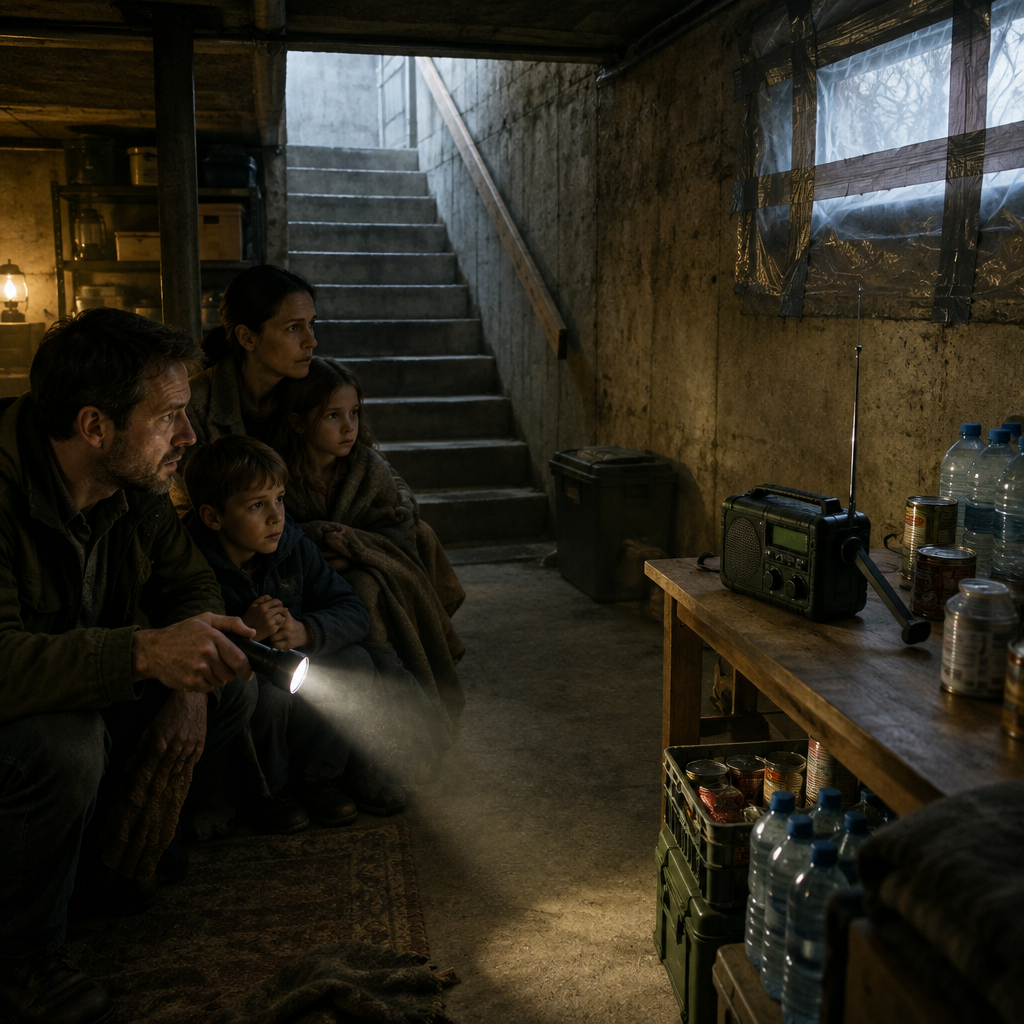
Then tighten the shelter itself. You're not building an airtight spaceship; you're keeping settled dust from drifting in. Duct tape and plastic sheeting over window frames, vent grilles, door gaps, and any opening that faces the wind. Close fireplace dampers. Turn off forced-air HVAC if the system draws from outside. The goal is a space that exchanges as little air with the outdoors as your comfort allows.
The Rest of Day One: Water, Food, and Information Discipline
Once you're sealed in and clean, the day gets boring on purpose. Eat only food that was sealed and stored indoors — cans, jars, pouches, anything with an intact factory seal. Drink only water that was indoors and sealed: bottled stock, the water heater tank, even the toilet tank reservoir (not the bowl) are all safer than anything fetched from outside. Municipal tap water may be contaminated or simply offline, and boiling does not remove radioactivity.
Your lifeline is a hand-crank or battery radio. Cell networks and power will be unreliable, and emergency broadcasters will announce radiation levels, evacuation instructions, and the areas they apply to. Tune in on a schedule — every hour is plenty — and write down what you hear. Resist rumor and social media; in a real event, bad information gets people killed when they leave good shelter for a "safer" area that isn't.
If public officials later instruct caliber-specific measures like taking potassium iodide, know what those tablets actually do before you swallow one — we cover the real limits of KI here.
Key Survival Takeaways
- Get inside, stay inside, stay tuned. It's the core CDC/FEMA doctrine because it works.
- Speed beats quality in the first hour. The best reachable shelter now beats the perfect shelter across town.
- The 7:10 rule is your friend. Radiation falls ~90% by the 7-hour mark; hold your position through the steepest part of the decay curve.
- Decontaminate at the door. Clothes off, gentle wash, no conditioner, before anyone settles in.
- Sealed and indoors is the food and water standard. If fallout couldn't touch it, you can use it.
- A radio is your only dependency. Everything else — grid, internet, phones — should be assumed down.
Related Gear and Emergency Supplies
Everything below earns its place in a 72-hour nuclear kit. Buy it before it's needed; after a detonation, none of it will be on a shelf.
- Hand-Crank Emergency Radio with NOAA Band - your connection to official guidance when the grid is dark
- Heavy-Duty Duct Tape in Multi-Packs - seal doors, vents, and window gaps fast
- 4-Mil Plastic Sheeting Rolls - barrier material for windows and vent openings
- Sealed Emergency Food Supply - factory-sealed calories that fallout can't touch
- Sealed Bottled Water Cases - the one water source you can trust without question
- N100/P100 Reusable Respirators - for the person who must open the door to the outside
Disclosure: As an Amazon Associate, Survival Video Hacks earns from qualifying purchases made through the links on this page. We link to gear categories we judge relevant to the scenario, not the most expensive items.
Frequently Asked Questions
How long do I actually have to stay inside?
Plan on 24 hours minimum and up to 72 hours for areas under heavier fallout. Because of the 7:10 decay rule, the first day is the dangerous one; after two to three days the outdoor dose rate is a small fraction of its peak. Follow emergency broadcast instructions for your specific area rather than the clock alone.
Does duct tape and plastic stop radiation?
No — nothing you tape to a window blocks gamma rays. What it stops is fallout dust, which is how most shelter contamination happens. The mass of the building handles the radiation; sealing the gaps handles the particles. Both jobs matter.
Can I shelter in my car instead?
Only as a last resort, and only if it's parked in a covered structure. A car's thin metal and glass barely attenuate fallout radiation. Its real value is as a container for supplies, not as a shield for people.
Should I try to drive away from the fallout zone?
Almost never in the first hours. The plume moves with the wind, roads will be chaotic, and being stuck outdoors mid-evacuation is the worst possible outcome. Shelter first, let the decay curve work, and evacuate later on official instruction if your area requires it. If leaving is part of your plan, see our nuclear bug-out bag checklist — and test your loadout with the free Bug-Out Bag Builder before you need it.
The Bottom Line
The first 24 hours after a nuclear attack are won by people who made boring decisions in advance: where they'll shelter, what they'll seal, what they'll eat, and which radio they'll trust. The physics is on your side — radiation decays fast, and sealed rooms hold. Your only real jobs are distance, mass, time, and clean information. Decide those four things now, and the worst day of your life becomes survivable.
Get the next breakdown
New video articles, gear notes from the field and tool updates — one email a week.
No spam. Unsubscribe any time. We never sell subscriber data.