Sanitation and Hygiene When the Grid Goes Down: A Complete Plan
A grid-down event does not stay a power problem for long. Within about a day, the water pressure drops, the toilets stop flushing, and the household has to answer a question almost nobody rehearses: where does everything go now? This guide covers the sanitation half of that problem, which is the half that actually decides whether a family stays healthy. The priorities are opening human waste handling, handwashing, dish and body hygiene, trash and pest control, and the water math that ties them together.
Why Sanitation Comes Before Comfort
Diarrheal illness is among the leading health threats after a disaster that disrupts water and sewer service, per WHO and CDC post-disaster guidance, and it spreads through exactly the conditions a blackout creates: crowded households, unwashed hands, contaminated water, waste near living space. The interventions are boring and cheap. Soap, a bucket, absorbent material and a few hundred feet of separation are the difference between a nuisance week and a medical emergency. Deal with what compounds first. A cold night is uncomfortable. One case of uncontrolled diarrhea with no running water becomes a dehydration problem, a water consumption problem and a contamination problem at once.
The Water Math Before the Waste Plan
Sanitation is a water problem, so get the numbers straight first. FEMA and CDC put minimum drinking and cooking water at roughly one gallon per person per day, and hygiene adds meaningfully on top. WHO guidance for basic hygiene puts the floor at two to six gallons per person per day; below that, handwashing and dish cleaning get genuinely hard. Households with infants, elderly members or anyone ill should plan at the upper end.
For a family of four over two weeks that is 80 to 170 gallons before cooking losses. Two 55-gallon drums plus smaller containers is a reasonable target. For container choices and safe storage, see water storage done right: barrels, dosing and rotation.
Human Waste: Building the Toilet System
The two-bucket method
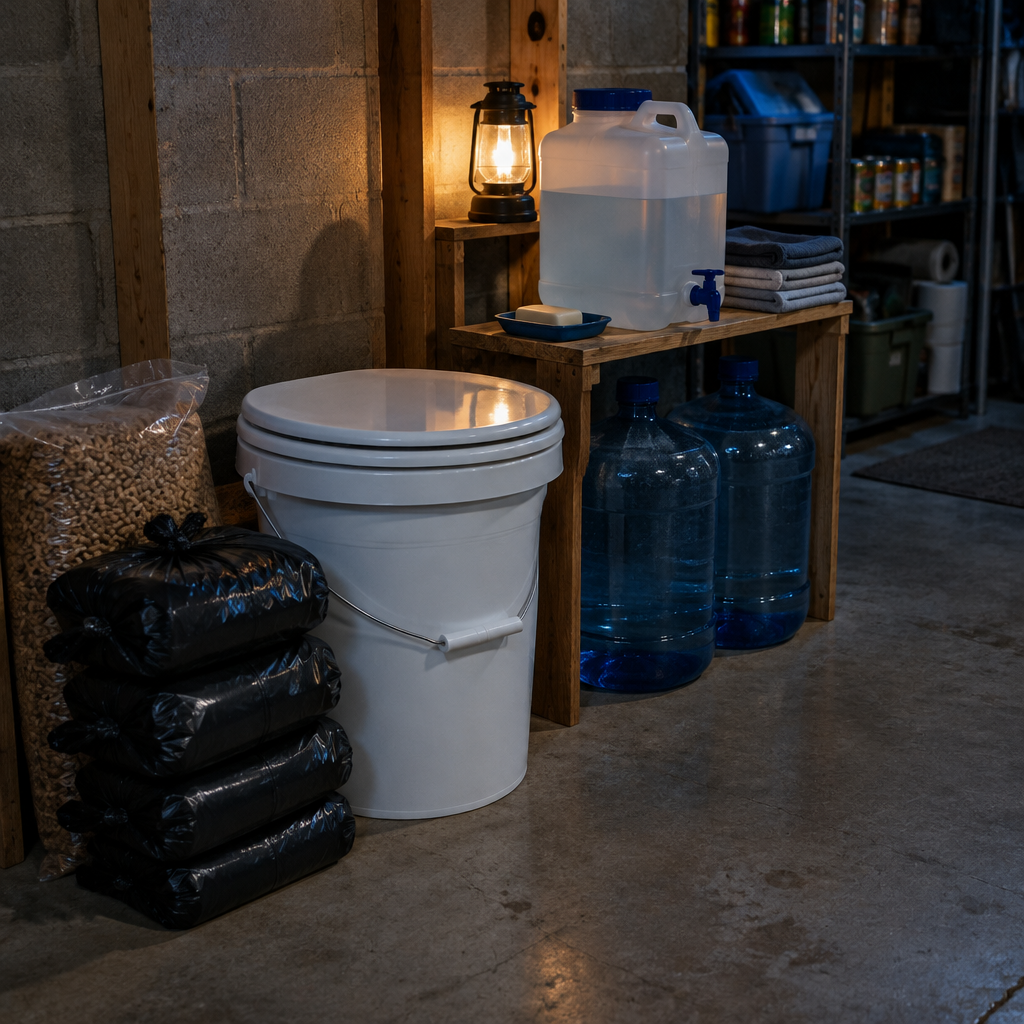
The practical household solution is a five-gallon bucket with a seat lid, lined with a heavy-duty bag, and half-filled with dry absorbent cover material: sawdust, pine pellets, shredded paper, or non-clumping cat litter. The cover material is not optional. Flies are the mechanical vector that turns a bucket into a disease spreader, and cover is what stops them. Keep two buckets, one in service and one staged, and put every full liner into a sealed secondary container rather than an open pile.
Solids, liquids, and the hard rule
Separate urine from solids. In a healthy person it is the volume driver behind odor and fill rate, and a dedicated container emptied daily keeps the solid bucket usable for a week or more. Never add urine to the solid bucket.
Disposal for households and neighborhoods
Sealed bags go out with regular trash once collection resumes. For longer events, burial is standard: holes six to eight inches deep, at least 200 feet from wells, streams and the water line, refilled after each deposit. For a multi-week event a trench latrine works better: about two feet deep, deposits covered with soil or cover material, closed over when the waste comes within a foot of the surface.
Do not spread raw sewage on a garden, dump it in a storm drain, or keep it inside living space past the working day. If someone in the household is ill, their waste is the one that matters most. Set it apart, handle it with gloves, and wash afterward as though it is contaminated.
Key Takeaways
- Sanitation is a water problem. Budget two to six gallons per person per day for hygiene on top of one gallon for drinking, and more if anyone is ill.
- Cover material controls the whole system. Sawdust, pine pellets, or cat litter over every deposit stops odor and flies, which is what stops disease.
- Separate urine from solids. Urine is the fill-rate and odor problem. Emptying it daily keeps a solid bucket usable for a week or more.
- Distance is protection. Bury waste at least 200 feet from any water source, and never in a garden or storm drain.
- Soap beats sanitizer. Handwashing with soap and running water for 20 seconds is the single highest-value action in the entire plan.
- Store the boring supplies now. Heavy-duty bags, bleach, soap, gloves, and absorbent material cost little and are the first things to vanish from shelves.
- Plan for the overlooked categories. Menstrual supplies, infant diapers, and pet waste are the three most commonly forgotten streams in household planning.
Handwashing Without a Faucet
This is the highest-return part of the guide. CDC guidance is unchanged in a disaster: soap and clean running water for at least 20 seconds, scrubbing backs of hands, between fingers and under nails. When running water is gone, a pour-over setup is the standard substitute: a jug with a spigot set above a basin, so gravity does the work and hands never touch a shared tap.
The classic field version is a tippy-tap, a container on a stick with a small hole and a string, tipped to release a controlled trickle. It uses a cup or two per wash and keeps every pair of hands off the same surfaces. Put one at the toilet station and one at the kitchen station, and treat them as separate. Hand sanitizer is a backup, not a replacement: it fails on visibly dirty hands and does not remove the physical contamination that causes diarrheal illness.
Bleach: The Ratios That Actually Matter
Unscented household chlorine bleach is the workhorse surface disinfectant, but the concentration on the label has changed over the years. Check the sodium hypochlorite percentage before mixing. For a standard 5.25 percent solution, CDC guidance is about one third of a cup per gallon of water, roughly four teaspoons per quart. Modern 8.25 percent concentrates need less: about three and a half tablespoons per gallon. Mix fresh daily, apply to hard non-porous surfaces, and let it sit wet for a minute before wiping.
Two hard rules: never mix bleach with ammonia, and never mix it with vinegar, since both produce dangerous gas. Never drink it or use it in place of proper water treatment, a separate procedure covered in emergency water preparedness: the first step to protect your family. Mix in a ventilated space, wear gloves, and label every container.
Body Hygiene, Dishes, and Laundry
Personal hygiene with limited water
A sponge bath with a quart of warm water handles most of what a shower does. Cleaning the face, hands, armpits, groin and feet is what actually controls odor and skin breakdown. Change socks and underwear daily even if nothing else gets washed, keep a separate washcloth per person, and dry them in the sun.
Dishes
Three basins is the standard: wash, rinse, then sanitize with bleach solution or boiling water. With water tight, reduce volume instead: scrape and wipe every plate first, wash in a small basin, rinse in a second, sanitize in a third. Paper plates for the duration are a legitimate choice and save gallons.
Laundry
A five-gallon bucket with a lid and a plunger is a working washing machine: agitate, soak, agitate, wring, line dry. Prioritize underwear, socks and anything used in food handling. Final rinse water can be reused for the toilet station.
Trash, Pests, and the Third Water Problem
Trash volume does not stop when collection does, and food waste becomes a rodent and fly problem within days. Separate dry burnable waste, food waste and sealed sanitation bags, and keep all of it outside living space. Burying food waste beats piling it. Standing water is the other half of pest control: after any rain, empty every container that holds it, including tarps, wheelbarrows and drum lids. Mosquitoes need a bottle cap of water.
The Supplies Worth Storing Now
The whole system fits on one shelf and costs less than most single gear purchases: two five-gallon buckets with lids and a seat, heavy-duty liners, pine pellets or sawdust, unscented bleach with a dropper, bar soap, gloves, paper towels, three basins, and a spigot container for handwashing. Add menstrual supplies, diapers in the right size, and a sealed container for pet waste.
Two adjacent systems matter once the outage runs past a few days. The staged sequence in the 72-hour blackout checklist covers the first hours of the event, and preparing for a long-term power blackout handles the extended version. Sanitation sits underneath both of them, and it is also where a stomach illness becomes a medical problem: if someone does get sick, the trauma and dehydration response in the field first aid guide is the reference to keep on hand.
Gear & Equipment
These are the pieces that make the system work in practice. A proper seat and lid, a real cover material, and a clean handwashing station are what turn a bucket into a toilet that a family will actually keep using for two weeks.
- Bucket Toilet Seat with Lid
- Pine Pellets Absorbent (40 lb)
- Heavy-Duty Bucket Liners
- Portable Handwashing Station
- 5-Gallon Water Container with Spigot
As an Amazon Associate, we earn from qualifying purchases.
Frequently Asked Questions
How long can you go without flushing a toilet before it becomes a health risk?
The risk starts as soon as the fixture cannot carry waste away, not after some grace period. As soon as water pressure drops, switch to the bucket system and stop using the toilet. Flushing a toilet with no supply only fills the bowl with waste that then has to be removed by hand, which is far worse than starting the bucket a day early.
Can I use cat litter as toilet cover material?
Yes, and non-clumping litter works well because it absorbs moisture and controls odor. Sawdust and wood pellets are usually cheaper in bulk and easier to compost later. Avoid clumping litter for this purpose since it turns into a heavy paste that makes the bag harder to handle.
Is it safe to bury human waste in the backyard?
For a short event, individual holes six to eight inches deep and at least 200 feet from wells, streams, and the water line are the accepted practice. Do not bury in a vegetable garden or anywhere that will be cultivated within a year, and do not bury near a foundation or in a spot that collects runoff. For longer events, a dedicated trench latrine away from water is the better answer.
How much bleach should I store for sanitation?
A single gallon of unscented household bleach is enough for months of surface disinfection at normal use, but it degrades over time: roughly half its strength within a year, faster in heat. Rotate it annually, store it in a cool dark place, and replace it rather than trusting a two-year-old bottle for disinfection. Also store a small dropper bottle so mixing ratios stay accurate.
What do I do with the waste bags when trash collection has stopped?
Seal them, keep them in a lidded secondary container outside the living area, and either hold them for collection or bury them. Never burn sealed plastic bags of waste in an enclosed space, and never store them in a garage attached to the house for more than a day. If the event is long, moving to trench burial is cleaner than accumulating bags.
The Bottom Line
Nobody prepares for sanitation because it is the least romantic part of preparedness, which is exactly why it is the most likely gap. Two buckets, a bag of pellets, soap, bleach and a handwashing jug solve the problem that takes most families by surprise on day two. Build the water reserve first, set up the stations before you need them, and rehearse the habit now rather than mid-emergency.
If your one weak spot is the bag you would grab on the way out the door, the Bug-Out Bag Builder walks through the loadout in about three minutes and tells you what your kit is missing.
Get the next breakdown
New video articles, gear notes from the field and tool updates — one email a week.
No spam. Unsubscribe any time. We never sell subscriber data.
Related reading