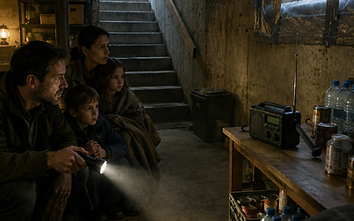
They're Preparing: What a 90-Day Military Standby Means for Your Household
News that military installations have been told to sustain essential operations for 90 days without outside support reads like a warning. City Prepping treats it as something more useful: a checklist. Whatever the reason behind the guidance, the exercise itself is worth copying, because every household sits on the same dependency chain that a base does. Electricity, water, fuel, communications, and medical care are the five systems your daily life rests on, and each one can fail independently of the others.
The shift in thinking is what makes this video valuable. Instead of asking what officials know, it asks which part of your own home stops working first. That question has an answer you can find this afternoon with no purchases and no forecasting. Below are the failure points worth auditing, how to test them honestly, and the gear that closes the gaps most households discover.
Key Survival Takeaways
- Audit the dependency, not the disaster. Do not prepare for a specific scenario. Walk through your home and list everything that stops working without grid power, then rank the list by how quickly the consequence becomes dangerous. Water and medical follow power almost immediately; entertainment never does.
- Ninety days is a planning horizon, not a prophecy. The value of a 90-day target is that it forces you past the three-day kit most households own and exposes the gaps that only appear in week two, like prescription refills, fuel rotation, and cash on hand when card readers are down.
- Water fails before food does. Stored food will carry you for weeks. Water runs out in days, and municipal pressure can drop the moment pumping stations lose power. Storage plus a purification method covers both the immediate outage and the longer contamination risk.
- Test with the breaker, not with imagination. Flip your main breaker for four hours on a normal day. You will find the real answers fast: what the fridge does, whether your backup heat is vented, whether your sump pump has a battery, and which devices you assumed were battery-backed and are not.
- Fuel and cash are the quiet single points of failure. Generators are useless without stabilized fuel, and fuel does not keep indefinitely without rotation. Cash matters because a regional outage often takes card processing down while shelves still hold goods.
- Communications planning beats communications gear. A radio you cannot operate in the dark is a paperweight. Decide in advance who you call, where you meet, and what a check-in schedule looks like when phones are unreliable.
Why the 90-Day Framing Works
Most household preparedness advice collapses into shopping lists. The 90-day standard is more demanding because it is a duration, and durations expose weaknesses that gear cannot hide. A three-day kit survives a storm. Ninety days forces you to think about rotation, storage volume, sanitation, medication continuity, and the morale problem of week three, when novelty has worn off and the situation is simply tedious.
That structure pairs naturally with existing planning work. If your household has already thought through surviving 90 days without power, the military framing is mostly a second opinion that confirms the same priorities: water first, then heat and medical, then communications. If you are starting from nothing, our guide to preparing for a long-term power blackout is the better entry point, because it sequences purchases in the order they actually matter rather than the order they appear in catalogs.
The Five Systems and Where They Break
Power is the root dependency. Lose it and water treatment, refrigeration, medical devices, communications, and heating controls follow in a cascade. The audit question is not whether you have a generator but what it can actually run, for how long, and whether the fuel to feed it is rotated.
Water has two distinct failure modes that people conflate. The first is loss of pressure, which is an inconvenience solved by stored water. The second is contamination, which is a health event solved only by purification, and which can persist long after pressure returns.
Fuel drives heat, cooking, and transport simultaneously. A single supply feeding three critical functions is a concentration risk worth breaking up with alternative options for at least cooking.
Communications fail in a way that is easy to miss: the network may stay up while local infrastructure that routes it does not, and congestion can black out service in a region even when towers are fine.
Medical is the least forgiving. Prescriptions run on refill cycles measured in weeks, and a 90-day horizon outlasts almost any standard refill window. Have that conversation with a physician before it is a problem, not during one.
Gear and Equipment
Closing the gaps found in an audit does not require a warehouse.
As an Amazon Associate, we earn from qualifying purchases.
Frequently Asked Questions
Is the 90-day military guidance a sign that something specific is coming?
Treat it as a continuity planning standard rather than a forecast. Militaries routinely set sustainment targets for installations because those facilities must function when supply chains are disrupted, whether by storm, cyberattack, or logistics failure. The useful takeaway is the duration itself, which is a sound benchmark for any household and does not depend on knowing why the guidance exists.
How much water should a household actually store for 90 days?
Plan on one gallon per person per day, which is 90 gallons per person across the full horizon. Most households cannot store that indoors, so the practical approach is a two-week buffer of stored water plus two independent purification methods and a known replenishment source. Storing some and filtering the rest is more resilient than storing all of it.
What is the fastest way to find my household's real weak point?
Kill the power for four hours on a Saturday and keep a notepad. Note every moment you reach for something that no longer works, including the thermostat, the garage door, the well pump, and the sump. The first three items on that list, ranked by how soon they become a safety issue rather than an annoyance, are your genuine priorities.
Should I buy a generator or a battery system?
They solve different problems. A generator runs high-draw appliances like a furnace blower or well pump but needs fuel, outdoor placement, and carbon monoxide discipline. A battery system runs quietly indoors for electronics, lights, and medical equipment but stores finite energy. Households with medical needs often want both, with the battery sized for overnight loads.
Final Thoughts
The most useful thing in this video is not a threat assessment. It is a question you can answer today: which part of your home stops working first. Answer it honestly, fix the earliest failure, and repeat. Preparedness built that way is unglamorous, but far more effective than a cart of gear bought in a hurry.
Get the next breakdown
New video articles, gear notes from the field and tool updates — one email a week.
No spam. Unsubscribe any time. We never sell subscriber data.
Related reading