Emergency Communication Plan: FRS, GMRS and Ham Radio
Emergency Communication Plan: FRS, GMRS and Ham Radio
Every disaster after-action report tells the same story in a different dialect: the towers were overloaded, the phones showed "No Service," and the people who did fine were the ones who had already agreed on where to meet and how to talk. Communication is the quiet pillar of preparedness. It does not look heroic on a gear list, but it is the difference between a family that converges on a plan and a family that spends 36 hours guessing.
This guide is the plan itself, not a shopping list with a philosophy stapled to it. You get the radio layers that work when cellular fails, the six decisions your household must make in advance, and a drill schedule that turns a laminated card into muscle memory. It follows published FEMA and FCC guidance and the real limits of consumer radios, including the ones the marketing copy glosses over.
Key Takeaways
- Cellular networks are the first utility to degrade and among the last to fully recover. Plan as if your phone is a convenience, not a lifeline.
- Three layers cover almost every household: FRS handhelds for local line-of-sight, GMRS for neighborhood and vehicle range, and ham radio for regional reach when nothing else gets through.
- A written plan with a fixed check-in window beats better hardware every time. Radios only help if both ends are listening at the same moment.
- One out-of-area contact, chosen for geography rather than closeness, solves the "everyone calling everyone" problem.
- Power is part of the plan. Radios with dead batteries are paperweights, so treat charging as a logistics problem you solve before the outage.
Why the Cell Network Fails First
Consumer cellular networks are engineered for average load, not peak demand. When a region loses power or evacuates at once, three things happen: tower sites fall back to battery and then generator power, backhaul links saturate, and millions of people pick up their phones simultaneously. The result is the pattern FEMA has documented in nearly every large-scale event: calls fail, texts sometimes squeeze through, and data crawls.
That last detail matters. A short SMS often gets through when a voice call will not, because it is a tiny packet queued and retried rather than a continuous connection. So the first rule of emergency communication is unglamorous: text before you call, and keep the message short and factual.
The deeper problem is architectural. A cellular network needs power, fiber, and functioning switching, and in a long outage all three are suspect. Radios that talk directly to each other, with no infrastructure in the middle, are the layer that survives when the network does not.
Pick Your Layers: FRS, GMRS, and Ham
Three radio services cover the realistic range of household needs. You do not need all three on day one, but you should understand what each one buys you so the money goes where it counts.
FRS: The Free, No-License Local Layer
Family Radio Service handhelds run 22 channels in the UHF band at up to 2 watts. No license, no callsign, no paperwork. In practice you get roughly a half mile to two miles in suburban terrain, more with elevation and line of sight, much less inside dense buildings or heavy timber. FRS is the right tool for a neighborhood, a campsite, or a school pickup line, not for reaching across a county.
Because FRS shares channels with GMRS, buying GMRS-capable radios gives you a path to more power later without replacing hardware. That is the most useful purchasing insight in this guide.
GMRS: Neighborhood and Vehicle Range With One License
General Mobile Radio Service allows up to 50 watts, repeater access, and detachable antennas. In the United States it requires an FCC license covering your immediate family; it costs about the price of a decent dinner and is valid for ten years. No exam. You pay, you get a callsign, you are legal.
The practical gain is real: a 5-watt handheld with a good antenna noticeably outperforms a 2-watt FRS unit, and a 40 to 50 watt mobile with an exterior antenna can reach 10 to 30 miles depending on terrain. Repeater access is the bigger prize. A hilltop GMRS repeater can extend effective range to 40 or 50 miles, which turns "the next town over" into a reachable address.
Ham Radio: Regional Reach When Nothing Else Works
Amateur radio is the deep layer. The Technician license requires a 35-question multiple-choice exam, no Morse code, and opens VHF and UHF privileges including local repeaters. General class adds high-frequency bands that reach hundreds or thousands of miles by bouncing signals off the ionosphere, with no infrastructure at all.
For most households, Technician is enough: 2-meter handhelds, local repeater nets, and the ability to pass traffic when commercial systems are down. Volunteer groups such as ARES and RACES plug licensed operators into county emergency management, a meaningful civic asset in a regional event. The honest version: ham radio is more capable and more demanding than most preppers admit. The real cost is learning your radio, your repeaters, and your net schedules before the night you need them.
Build the Plan: Six Decisions to Make Before You Need It
Hardware is the easy part. These six decisions are what separate a plan from a drawer full of radios.
1. Define the Roster and the Roles
List every household member and everyone you are responsible for: kids at school, an elderly parent two towns over, a spouse with a commute. For each, note where they are likely to be at 9 a.m. on a weekday and what they carry. Assign one person as communications lead, the one who monitors during the check-in window and logs traffic. In a crisis, ambiguity about who is listening is how messages die.
2. Set a Fixed Check-In Window
Choose two times a day, roughly twelve hours apart, and commit to them: 8:00 a.m. and 8:00 p.m. local works. Everyone monitors for fifteen minutes, transmits a status, then drops back to low power to save batteries. Fixed windows solve the hardest problem in radio: two people who own radios but never have them on at the same time.
3. Choose Primary and Fallback Channels
Write the channel plan in priority order. A workable suburban example: primary is a designated FRS/GMRS channel with a set privacy code, fallback one is a second channel with no code for interference, fallback two is a ham simplex frequency, fallback three is the out-of-area phone contact. Publish it on a card in every bag and on the refrigerator, with channel numbers as numbers. In a stressful moment nobody parses "the one after the weather channels."
4. Agree on a Message Format
Keep transmissions under fifteen seconds and lead with the important part. A simple format works: who you are, where you are, status, need. "This is Dad, at the house, everyone safe, no power, need nothing." That is a complete transmission. Teach it to your kids the way you teach a phone number.
5. Plan the Power
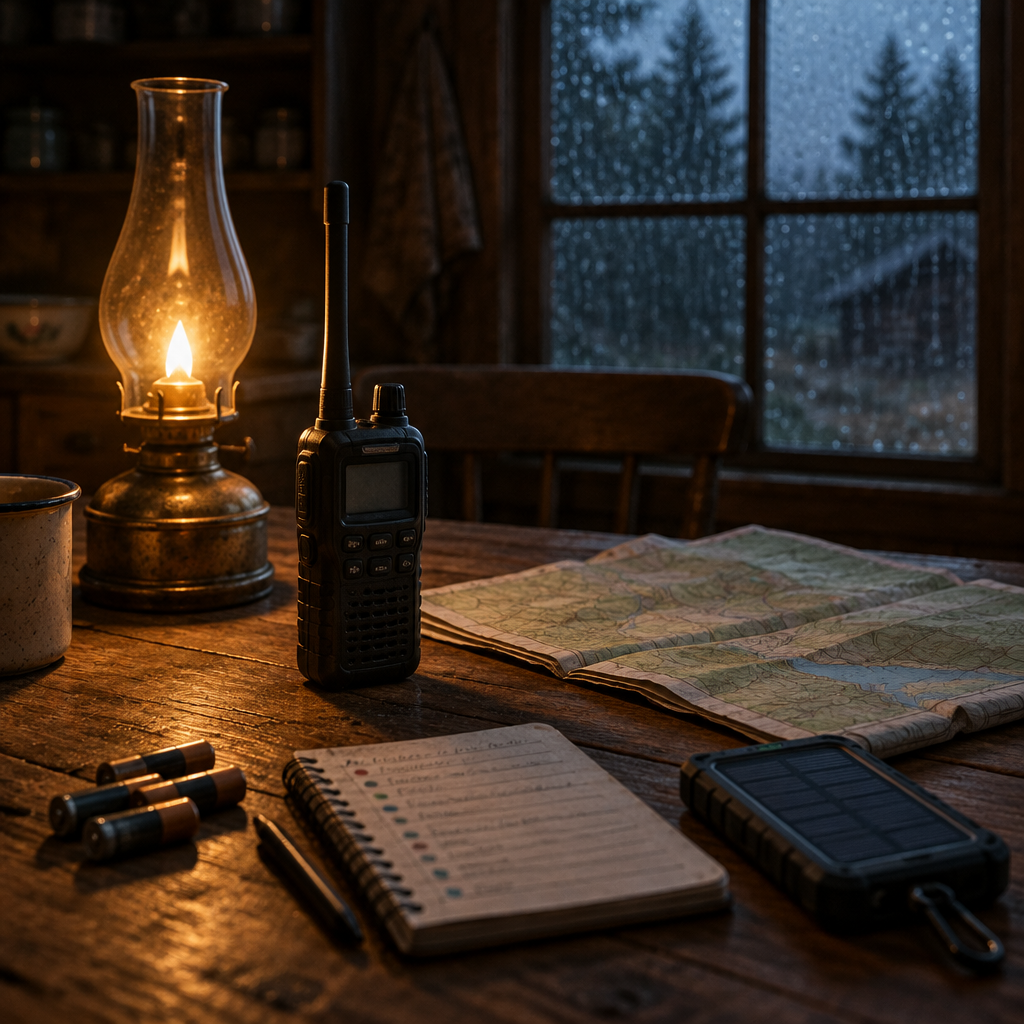
Assume wall chargers are dead for a week. Count your radio batteries, then double the count. Standardize on one chemistry where you can, add a solar panel with USB output, and keep a battery bank charged and rotated. Do not let a proprietary lithium pack be your only option, because in a long outage that pack becomes a countdown timer.
6. Set the Rally Point and the Out-of-Area Contact
Pick one out-of-area contact, ideally 100 or more miles away, and make them the clearinghouse. After a regional event, local circuits jam but long distance often works. Everyone reports to that person, who relays. Then pick two rally points: one within walking distance of home, one outside the neighborhood. A comms plan without a meeting place is half a plan.
Practice: The Quarterly Radio Drill
A plan you have never executed is a hypothesis. Run a short drill once a quarter: hand everyone their radio, announce a scenario, and have each person transmit a formatted status from a different room or part of town. Time how long it takes to account for everyone. Once a year, do it with the power off and the phones in a drawer.
Log what breaks. It is usually the same three things: a battery nobody charged, a channel mismatch, and one person who did not know which button to press. Cheap to fix in advance, expensive to discover at 2 a.m.
Gear & Equipment
These are the categories worth spending on. Buy the license before the second radio, and buy antennas before amplifiers.
As an Amazon Associate, we earn from qualifying purchases.
Frequently Asked Questions
Do I need a license to use a walkie-talkie in an emergency?
For FRS radios, no license is required at all. GMRS requires an FCC license for normal use; the FCC does allow unlicensed operation on GMRS frequencies in a genuine life-or-death emergency, but relying on that exception as your plan is unwise, and the license is inexpensive and exam-free. Ham requires a Technician license, though operators may use any means available to summon help when life is at risk.
What is the realistic range of a GMRS handheld?
One to three miles in suburban terrain, five or more over open water or flat country with elevation, and much less inside steel-and-concrete buildings. Manufacturer range claims are measured hilltop to hilltop with clear line of sight and should be treated as marketing. A better antenna and higher position beat a bigger radio.
Can I use a ham radio without a license if the grid is down?
Not for routine communication. The emergency exception is narrow: it applies when there is an immediate threat to life or property and normal means are unavailable. Owning a ham radio as a grid-down backup without a license means you cannot legally practice with it, and an operator who has never practiced is not much of an asset. The Technician exam is 35 questions and can be taken online.
What should I do first if cell service goes out?
Send a short text instead of calling, because a queued text packet often gets through when a voice circuit will not. Then switch to your written plan: monitor your primary channel at the next scheduled check-in window and contact your out-of-area person. Resist the urge to call everyone in your contacts list, which adds to the congestion that is already blocking you.
How do I find local GMRS or ham repeaters?
Repeater directories such as RepeaterBook list GMRS and amateur repeaters by location, frequency, offset, and access tone. Program your local repeaters into your radios before an emergency and confirm they are active during a routine weekly net. Our guide to signaling for rescue with radios, mirrors and light discipline covers what to do once you actually reach someone.
Bottom Line
The household that communicates well in a crisis is not the one with the most capable radio. It is the one that decided, on a quiet Tuesday, who calls whom, on what channel, at what hour, and where everyone meets. Write it down, put it in every bag, and run the drill.
Radios are one layer of a larger kit. If your go-bag is still a work in progress, the Bug-Out Bag Builder walks you through the loadout in about ten minutes and tells you what you are missing. Pair it with our 72-hour blackout checklist and our grid-down power guide, and you will have the three pillars that matter most: light, power, and a way to talk.
Get the next breakdown
New video articles, gear notes from the field and tool updates — one email a week.
No spam. Unsubscribe any time. We never sell subscriber data.