When the grid goes down and the internet is a memory, the books on your shelf become your most valuable survival tool. You can stockpile the best gear, build elaborate shelters, and cache supplies for years — but without the right knowledge stored in your mind, all of it becomes useless dead weight when you need it most. A well-curated survival library is the one piece of equipment that never runs out of batteries, never breaks, and becomes more valuable the more you use it.
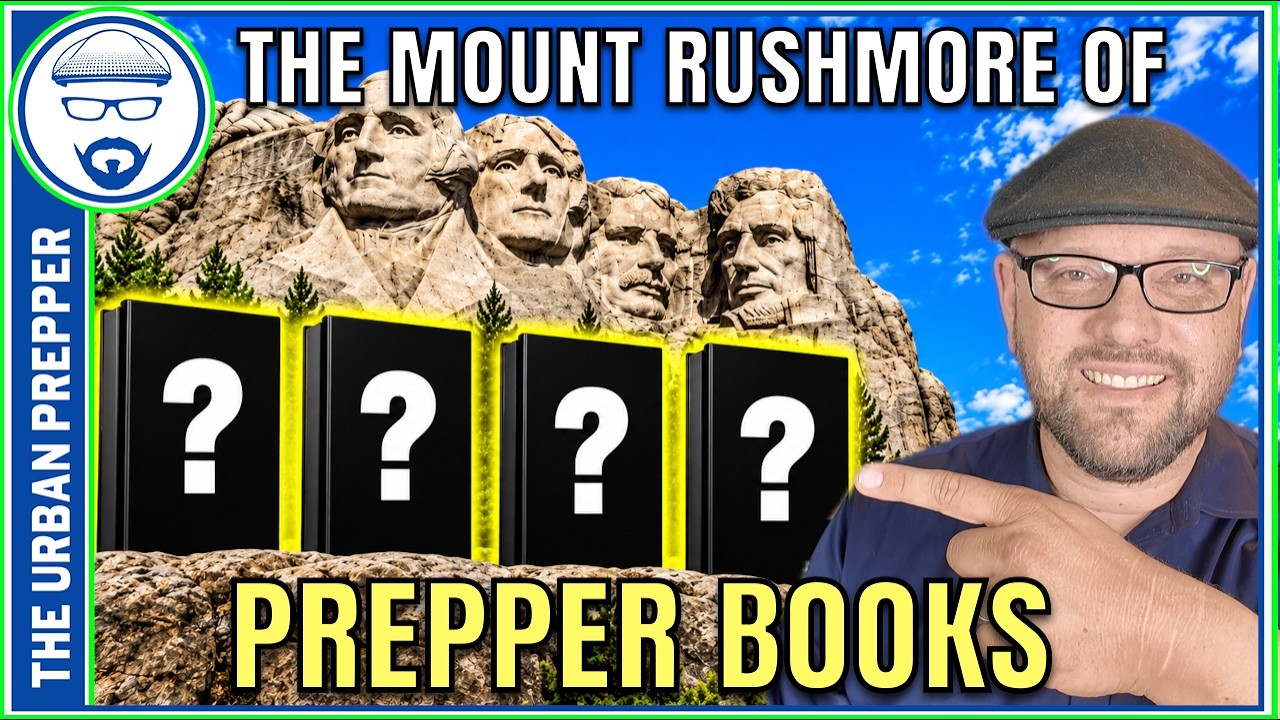
In this installment of the Mount Rushmore series, TheUrbanPrepper identifies the four preparedness books that have had the most profound impact on the survival and self-reliance community. Rather than ranking multitools or reviewing the latest gadgets, this video takes a deeper look at the foundational texts that shaped modern preparedness. The selection criteria are rigorous: historical influence, longevity, innovation, community impact, and cultural significance. These aren’t just popular books — they’re the ones that changed how people think about survival and self-reliance.
Here’s the truth that most gear reviewers won’t tell you: in a real emergency, skills trump stuff every single time. A five-hundred-dollar knife won’t save you if you don’t know how to use it, but a twenty-dollar book read thoroughly could save your life dozens of times over. These four books have been tested not just by their authors but by generations of readers who put their teachings into practice in real-world crises across the globe. Let’s break down what makes each one essential.
Key Survival Takeaways
- SAS Survival Handbook by John “Lofty” Wiseman — Written by a 26-year veteran of the British Special Air Service, this handbook is widely regarded as the most comprehensive single-volume survival guide ever published. It covers shelter construction, water procurement, fire starting, food foraging, navigation, and first aid across every climate from desert to arctic. Its compact format makes it practical to carry in a bug-out bag, and its clear illustrations ensure critical information is accessible even under extreme stress.
- The Encyclopedia of Country Living by Carla Emery — This isn’t a short-term survival manual but a roadmap to long-term self-sufficiency. Spanning over 900 pages, it covers homesteading fundamentals: growing and preserving food, raising livestock, making soap, brewing, and building infrastructure from scratch. For preppers focused on sustainable living rather than just bugging out, this book is the definitive reference for rebuilding a functional, self-reliant life from the ground up.
- Nuclear War Survival Skills by Cresson H. Kearny — Developed at Oak Ridge National Laboratory during the Cold War, this guide addresses the most extreme preparedness scenario with scientifically grounded, field-tested methods. It includes detailed plans for building expedient fallout shelters, improvised radiation meters from common household materials, and ventilation systems for enclosed survival spaces. While the topic is sobering, the practical engineering approach makes it uniquely valuable among survival texts.
- Where There Is No Doctor by David Werner — Originally written for health workers in rural Mexico, this book has become the most widely used healthcare manual in the world. It covers diagnosis and treatment of hundreds of conditions, from infections and fractures to childbirth and malnutrition, using simple language and clear illustrations. For preppers, it fills the critical gap of medical knowledge when professional emergency services are unavailable or hours away.
- Selection criteria: Each book was chosen based on five factors — historical influence, longevity, innovation, community impact, and cultural significance — ensuring they represent the best of the preparedness genre rather than simply the most popular or most recently published.
- Complementary coverage: No single book covers everything. The SAS Handbook excels at short-term wilderness survival, The Encyclopedia of Country Living focuses on long-term self-reliance, Nuclear War Survival Skills addresses extreme disaster scenarios, and Where There Is No Doctor fills the critical medical gap. Together, they form a nearly complete preparedness education.
- Practical application: These books aren’t meant to sit on a shelf collecting dust. Reading them thoroughly before a crisis means you’ll have the knowledge internalized when seconds count, and keeping physical copies in your kit provides a reference you can return to under pressure when internet access is gone.
Build Your Survival Library
Building your survival library starts with these four foundational titles. Each one covers a completely different dimension of preparedness — from immediate wilderness survival to long-term homesteading self-reliance, from nuclear disaster engineering to emergency medicine in austere conditions. While digital copies are convenient for quick reference, physical books don’t need charging and should be the priority for your preparedness library. Grab copies for both your bookshelf and your bug-out bag:
- SAS Survival Handbook — The ultimate all-environment survival manual by a former SAS soldier.
- The Encyclopedia of Country Living — The complete homesteading reference for sustainable self-reliance.
- Nuclear War Survival Skills — Field-tested civil defense engineering for worst-case scenarios.
- Where There Is No Doctor — The world’s most widely used village healthcare manual for off-grid medicine.
As an Amazon Associate, we earn from qualifying purchases.
Final Thoughts
A survival library is the one investment that appreciates over time. These four books have earned their place on the Mount Rushmore of preparedness literature because they cover the full spectrum of survival knowledge — from immediate wilderness emergencies to nuclear fallout, from homesteading self-sufficiency to emergency medicine when no doctor is available. Don’t wait for a crisis to start reading. Build your library now, study the material thoroughly, and keep physical copies in your kits. Knowledge weighs nothing but is worth everything when it matters most.