



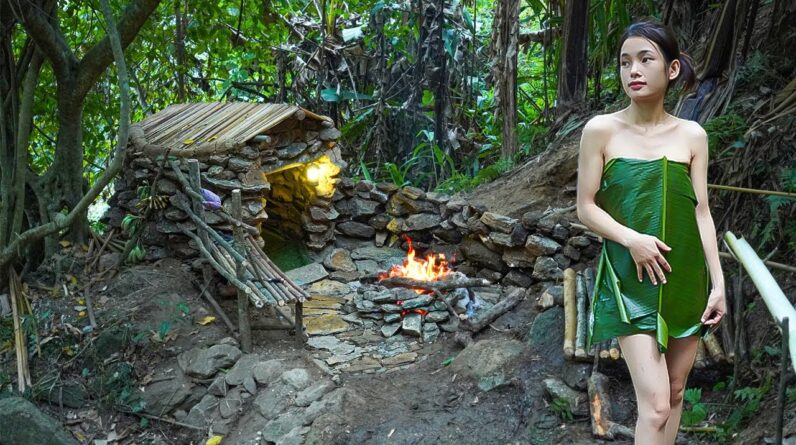
Sustained wilderness survival relies on transitioning from temporary emergency lean-tos to semi-permanent bushcraft structures that offer genuine weather protection and long-term security. In this ten-day solo survival footage, primitive builder and bushcrafter demonstrates the art of constructing a stone cabin, harvesting wild food sources like honey and fish, and managing thermal mass heating in the forest.
Unlike light debris huts, stone masonry cabins utilize non-combustible, dense materials that trap radiant heat from internal fireplaces while providing impenetrable wind barriers. By combining dry-stack stone techniques with wet clay mortar and wild foraging strategies, bushcrafters can live comfortably in rugged environments for extended periods without relying on modern amenities.
Stone Masonry and Clay Mortar Construction Techniques
Constructing a durable stone shelter begins with selecting and sorting suitable fieldstones. Flat, broad rocks are reserved for foundational footings and wall corners, providing stability and preventing uneven settling into forest topsoil. Interlocking stone joints—placing each rock so it spans the seam between two stones below it—ensures structural loads are evenly distributed throughout the wall.
To seal wind gaps between stones, primitive builders harvest sticky riverbank clay and mix it with fine sand and organic fibers like dried moss or grass. This natural mortar fills voids between irregular stone faces, creating a tight seal that prevents freezing wind from penetrating the living area. Clay mortar also adds cohesive strength to the dry-stack wall, hardening into a durable adobe-like cement as it cures near heat sources.
The addition of an integrated stone fireplace inside the cabin provides both cooking capability and continuous radiant heat. Stones absorb heat energy from burning hardwood fires and slowly release thermal radiation back into the living chamber long after embers have died down. However, builders must avoid using wet river rocks directly inside fire pits, as trapped moisture inside porous stones can vaporize, expand rapidly, and cause rocks to fracture violently when exposed to intense heat.
Wild Food Harvesting: Foraging, Fishing, and Honey Collection
Maintaining energy levels during a multi-day bushcraft build demands active wild food procurement. In this challenge, the builder combines multiple primitive food procurement techniques: trapping small fish in tidal streams, gathering wild ant larvae for protein, and carefully harvesting wild honey from forest bee colonies.
Wild honey represents a concentrated source of pure carbohydrates, sugar calories, and antimicrobials that are invaluable in survival scenarios. Safely harvesting honey from feral hives requires smoke management to calm bees before cutting honeycombs. Utilizing green leaves or smoldering punk wood produces thick, cool smoke that masks honeybee alarm pheromones, allowing bushcrafters to harvest honeycomb without sustaining dangerous stings.
Pairing wild honey with harvested fish or wild plant tubers creates balanced, calorie-dense wilderness meals. Cooking over open stone hearths or hot coal beds sterilizes food while preserving vital fats and proteins needed to sustain heavy physical labor during shelter building.
In addition to protein and calories, maintaining camp hygiene and hydration during extended stays is essential. Boiling water in clay vessels or hot-stone boiling techniques ensures that all surface water collected from nearby creeks is free from waterborne pathogens before consumption.
Key Survival Takeaways
- Lay Heavy Stone Foundations: Position large, broad rocks at the base and corners of stone walls to create a level, drift-free foundation.
- Use Interlocking Joint Patterns: Stagger stone seams across courses to prevent vertical stress cracks and maximize structural wall integrity.
- Apply Clay-Sand Mortar Sealing: Fill gaps between dry-stacked rocks with sticky clay mortar to eliminate cold wind drafts and improve insulation.
- Avoid Wet River Rocks in Fireplaces: Sourcing dry ridge stones prevents hazardous steam pressure explosions inside hot fire hearths.
- Leverage Smoke for Honey Harvests: Use cool, dense smoke from smoldering green vegetation to pacify wild bees before harvesting nutrient-dense honeycomb.
- Harness Thermal Mass Radiance: Build heavy stone fireplaces to absorb fire heat and radiate gentle warmth into the shelter throughout cold nights.
Gear & Equipment
Executing long-term bushcraft projects and stone shelter builds requires dependable field tools for timber processing and camp maintenance:
- Bushcraft Hatchet Axe – Ideal compact axe for felling small timber, processing firewood, and shaping roof beams.
- Stainless Steel Camping Mess Kit – Durable cookware for boiling wild forage, frying fish, and rendering honeycomb over campfires.
- Wilderness Mosquito & Bee Head Net – Lightweight mesh protection against stinging insects when harvesting honey or working in dense brush.
- Pocket Fire Bellows Collapsible Tool – Concentrates oxygen flow to reignite smoldering coals quickly without blowing ash into food.
As an Amazon Associate, we earn from qualifying purchases.
Conclusion
Transitioning to stone cabining and active wild foraging provides the foundation for true long-term wilderness self-reliance. By combining durable masonry construction with smart food procurement like smoke-assisted honey harvesting, survivalists can thrive in rugged outdoors indefinitely. Practice these core bushcraft principles on your next expedition to elevate your primitive survival capability.




You are harming the environment. Do not remove the stones dude
💀🤌🏻
But good video nigga❤
Отличная работа! Умница!!🎉🎉🎉🎉
Wow So Attacktive Strong N Beautiful.A Richest Style House.Nice N Very Symple Idea.
Kỹ thuật xếp đá thật là tuyệt vời 🎉🎉🎉🎉🎉
Beatifull stone…still no toilet…dont pee n poo at the river
this is really unbelievable and yet beautiful. very very very creative work with these stones.
Super creative.. great.. I hope you will be more enthusiastic, grow your channel ❤
Nice video bro ❤❤❤❤❤
I love nature
หินโครนจะไช้ได้หินซายก้อไช้ได้หมดแต่ก้อไม้ดีดินแหร็กดีสุดสังกะสีนั้นดี
One of my favorite parts is when they stop and prepare their meals after a hard days work,very satisfying as a viewer.
山上的東西,好像什麼都可以吃
你的作品很棒
那個蜜蜂不會,丁人嗎
Do what you want to do sir,coz god give you that ,all i can do is watch your vlog,and amazed every house that you made.i wish i have that skills toO .god bless you and always be safe.❤❤❤
48:06 …que es eso? 🤔
Почему камни не скрепляются раствором?
Excelent ¡¡¡🤩👍
Một căn nhà xây bằng đá rất sáng tạo chắc chắn và đẹp quá là oke cháu ơi..chúc mừng một kiệt tác mỉ mản….
Eres un arquitecto de los pies a la cabeza..no dejes que ese don que tienes quede a la historia enseña a las personas que quiera aprender 💪👏👏👏
Wow you build a magical stone forest cabin.
He is an incredible builder and a master craftsman. 😊
저많은 돌을주워온게 더 대단하다
How amazing to be able to do what you do. Love ❤️ your content.
Don't like it when nature gets disturbed by man😢
cả gia đình tôi có thể sẽ xem video của bạn, nhưng tôi chỉ nhìn khuôn mặt của bạn vì bạn hấp dẫn chỉ chờ bạn cởi áo phông ra 😅
I dont care about the obvious fakeness of these usually, because you get lost in the fantasy of it, but the perfect boards part at 33 minutes made me laugh
M gustaría que los comerciantes fueran en español.asi m enteraría de lo que disen.m gusta ver los vídeos.pero no entiendo nada delo que Disen.🙏🍀
ăn mật ong rừng với trứng kiến uống nước suối mà sống làm việc đc phai nói đáng phuc thật …
ko thể nào tin nổi nếu ko có người hỗ trợ …
Very cool
I really wish we were friends
Cómo tira basura, deberían cuidar el agua,cuidar el planeta 🌍🌍🌍🌍🌍🌍🌍🌍🌍🌍 😢😢😢😢😢😢😢y dejar de. derribar tantos árboles 😢😢
Bravo 👏🥰😍
Too close to river
Although I disapprove destroying nature. But Kudos to the camera man and behind camera support staff for carefully hiding during the whole period
19:00 WTF you want us to believe that BS
Hutan yang bagus suasana menyenangkan
Does the jungle have poison ivy? I couldn't believe you were pulling brush with your bare hands! Where is this jungle at? Awesome work!
Very good, like ❤❤❤❤
Super ❤
U got to make sure NO TREES ARE CUT DOWN for a silly YouTube project