Field Article // Gear Reviews
Survival Knife Steel Explained: Choosing a Blade That Holds an Edge
Steel type matters far less than geometry, and geometry matters less than knowing how to sharpen. Here is what actually holds an edge in the field.
Key takeaways // 30-second read
- Wear resistance, toughness and corrosion resistance trade off against each other — 1095 wins on resharpening, 3V on toughness, stainless on maintenance.
- Geometry matters more than alloy: 3–5 mm thickness, a flat or scandi grind at 15–20 degrees, and 4–5 inches of blade cover most field tasks.
- Carry a coarse and a fine stone plus a strop; keeping an edge workable every evening prevents the field repair you cannot do in the dark.
- Baton straight-grained wood with a wooden baton on the spine near the tip, working down the length — never pry with the blade.
- Avoid folding knives for hard use, thin hollow grounds sold as survival blades, and any task that involves levering.
The three properties you cannot have at once
Every knife steel is a compromise between wear resistance (edge holding), toughness (resistance to chipping and rolling) and corrosion resistance. Improving one costs you another, and heat treatment matters more than the alloy name on the blade.
- 1095 carbon steel. The traditional choice: takes an edge quickly with a pocket stone, tough enough for batoning, and cheap to replace. It rusts, so it needs drying and oiling.
- CPM-3V. The modern tough-steel benchmark. Excellent impact resistance and good edge holding, but harder to sharpen in the field and considerably more expensive.
- 14C28N and similar stainless. Good balance of corrosion resistance and toughness, easy to maintain, less edge retention than high-vanadium steels.
- High-hardness tool steels (M390, S30V class). Superb edge retention, but chippier at thin geometry and annoying to restore without diamond stones.
Geometry beats the spec sheet
A well-ground 1095 blade outperforms a badly ground super steel every time. What matters in the field:
- Blade thickness: 3 to 5 mm for a hard-use knife. Thicker does not mean stronger — it means heavier and worse at slicing.
- Grind: a flat or scandi grind at 15–20 degrees per side for a knife that carves and batons well. A thin convex grind slices beautifully but chips when pried.
- Blade length: 4 to 5 inches covers almost every field task. Longer blades are for chopping, which a saw or hatchet does better.
- Handle: micarta or G10 for grip when wet. A full tang with visible metal is the durability baseline.
Sharpening is the real skill
Carry two stones — a coarse diamond or ceramic for re-beveling and a fine one for finishing — plus a strop. In the field, ten strokes per side at a consistent angle every evening keeps an edge working indefinitely. Repairing a badly rolled edge in the dark is the scenario you are avoiding.
Batoning, done without breaking the blade
- Choose straight-grained, knot-free wood, and cut to lengths shorter than the blade.
- Place the blade tip on the wood with the edge facing the grain at 90 degrees, not leveraged sideways.
- Strike the spine of the blade near the tip with a wooden baton, never a metal hammer or a rock.
- Work down the length: baton from the tip end first, and stop if the blade starts to bind — rotate and re-strike rather than prying.
What to avoid
- Folding knives for hard use. Locks fail under batoning loads; carry a fixed blade.
- Hollow-ground blades with thin edges presented as survival knives — they chip on bone, wire and knots.
- Novelty hollow-handle knives with poor tang structure and brittle stainless.
- Prying. A knife is a cutting tool; the moment you lever with it, you are gambling the whole blade.
Gear & Equipment // Tested
The gear we actually run
Bought at retail and used in the same drills described above. Links are affiliate links — they cost you nothing extra and keep this site independent.
As an Amazon Associate we earn from qualifying purchases.

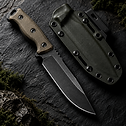
Amazon pick · Tools
1095 Carbon Fixed-Blade Survival Knife
Full tang, 4–5 inch blade, easy to resharpen in the field with a stone. Carbon steel takes an edge fast and tolerates batoning.
Street price: $40–$120
Check price on Amazon
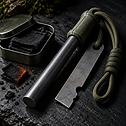
Amazon pick · Fire
Ferro Rod Fire Starter + Striker
5,000+ strikes at 3,000°F, works soaking wet, and needs no fuel. A thick 1/2-inch rod is easier on cold hands than the thin ones.
Street price: $12–$25
Check price on AmazonFAQ // Read before you buy
Frequently asked questions
Newsletter // article
Get the next breakdown
New video articles, gear notes from testing and tool updates — one email a week.
No spam. Unsubscribe any time. We never sell subscriber data.
Keep going // 1 more
Related reading

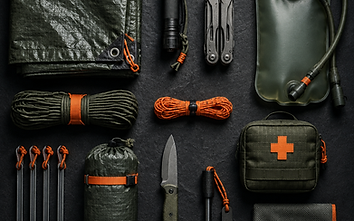
How to Build a Bug-Out Bag That Actually Works
Most bug-out bags are too heavy to carry, packed in the wrong order, and missing the one item that matters. Here is the layout and the wear test that fixes it.